The hardware behind
every reservation.
ARO deploys current-generation NVIDIA GPUs in 8-GPU nodes (servers) from Supermicro and MSI, in liquid-cooled racks inside U.S. data centers, with 100 GbE fiber out to you. The NVIDIA B300 leads. The detail below is what we hand a tenant's technical lead.
One reference design, four building blocks.
Compute, network, cooling, and power. Each is engineered to data center thresholds, and each is tuned to the site and the workload before anything is ordered.
01 / Compute
NVIDIA B300
B300 with 288 GB HBM3e per GPU leads. RTX, H-series, and B-series supported. Eight GPUs per node, NVLink-connected.
02 / Network
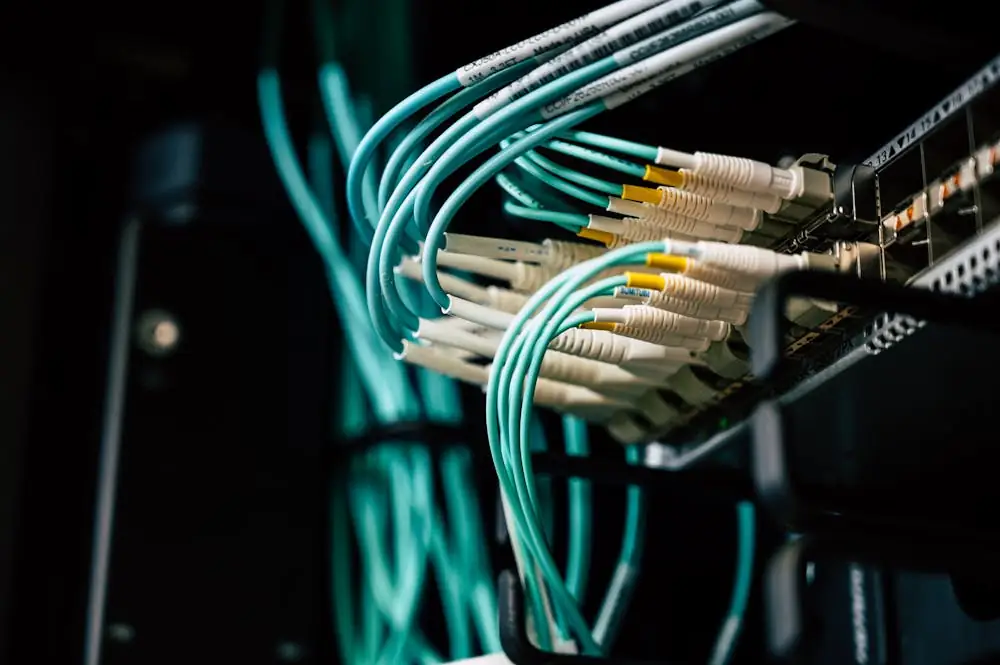
100 GbE backhaul
Redundant fiber paths out of every site. NVLink inside each node, high-speed InfiniBand or Ethernet between nodes for multi-node clusters.
03 / Cooling
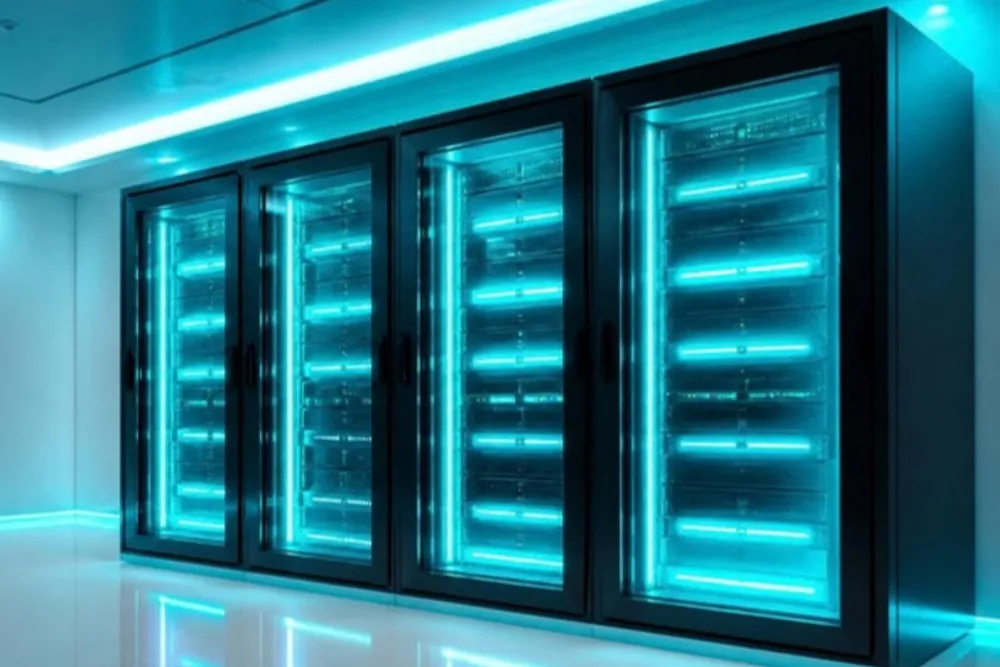
Liquid-cooled racks
Rear-door heat exchange and direct liquid cooling, sized to rack density. Motivair as the cooling partner.
04 / Power
415 V three-phase
Data center power with UPS and generator backing. Rack densities sized to the server configuration, not the other way around.
Current-generation NVIDIA, chosen for the workload.
ARO's lead GPU is the NVIDIA B300, the Blackwell Ultra data center GPU with 288 GB of HBM3e per GPU. Eight B300s in one node put more than 2 TB of GPU memory behind a single NVLink domain, which is what lets large models and long contexts run on fewer GPUs with less sharding overhead.
Limited NVIDIA H200 capacity (141 GB of HBM3e per GPU, Hopper generation) is also available while supply lasts, for teams whose software already targets Hopper. Ask about current availability.
ARO also supports RTX, H-series, and B-series GPUs for workloads that fit them, including smaller single-node deployments at our Micro Edge Computing hubs, and we keep pace with new NVIDIA generations through our hardware partners. The server vendor is chosen per deployment from Supermicro and MSI.
What is a node?
A node is one GPU server: eight NVIDIA B300 GPUs connected by NVLink, plus the server's own processors, memory, storage, and network cards. It is the unit ARO reserves, prices, and monitors. Several nodes share one liquid-cooled rack, and nodes in a cluster connect to each other over a high-speed InfiniBand or Ethernet fabric.
Per-node reference configuration
- GPUs: 8 x NVIDIA HGX B300, 288 GB HBM3e each (over 2.3 TB per node)
- GPU interconnect: NVLink and NVSwitch on an HGX B300 NVL8 baseboard
- CPUs: 2 x Intel Xeon 6768P, 64 cores each (128 cores per node)
- System memory: 2 TB DDR5-6400 ECC
- Local storage: 8 x 3.84 TB E1.S NVMe data drives, plus 2 x 960 GB M.2 boot drives
- Node networking: 8 x NVIDIA ConnectX-8 SuperNICs, up to 800 Gb/s each
- Between nodes: NVIDIA Quantum-X800 InfiniBand at 800 Gb/s, recommended for distributed training; 400 or 800 GbE Ethernet for Ethernet-standardized environments
- Management: dual 10 GbE plus a dedicated 1 GbE BMC port on an isolated management network
- Tenant backhaul: 100 GbE fiber out of the site
- Power: 15 kW design power per node
- Platform: 8U server from Supermicro or MSI, chosen per deployment
Example: an 8-node, 64-GPU cluster brings 18.4 TB of GPU memory, 1,024 CPU cores, 16 TB of system memory, about 246 TB of NVMe data storage, and a 120 kW IT load. Final configuration is confirmed in your deployment data sheet.
What you can run
- Production LLM inference and agents, large models and long contexts across a single NVLink domain.
- Multi-modal and vision, image, video, and audio inference with memory headroom.
- Fine-tuning and RAG, tenant-specific adaptation on isolated nodes.
- Multi-node training, on dedicated clusters with a high-speed fabric between nodes.
100 GbE out. NVLink in.
Dedicated capacity only matters if the network gets out of the way. Every ARO deployment lands on a 100 GbE tenant backhaul with redundant fiber paths, in multi-carrier facilities, onward to the public internet or to your private connection.
Inside each node, the eight GPUs are connected over NVLink, so tensor-parallel workloads scale across the node without saturating the host bus. Between nodes, multi-node clusters use a high-speed InfiniBand or Ethernet fabric sized to the cluster.
For tenants with their own networks, we support direct connect and private VLAN handoff, useful when egress costs and data-residency posture matter more than internet-routed throughput. For regional Micro Edge Computing hubs, we design for sub-10 ms tenant-to-hub round-trip latency targets.
Liquid where it matters. Sensible where it doesn't.
Modern GPU racks run far beyond what air alone can carry. ARO deploys in liquid-cooled racks, with rear-door heat exchange as the baseline and direct liquid cooling where the server configuration calls for it. Motivair is our cooling partner.
At data center sites, the facility provides conditioned power, chilled water, and the mechanical plant. At Micro Edge Computing hubs, ARO installs a closed-loop system fed by the property's water supply, and the hub runs silent inside the room.
Power profile
- 415 V three-phase service per rack, with UPS and generator backing at data center sites.
- Rack power sized to the server configuration.
- Behind-the-meter generation or microgrid integration at qualified sites, where utility queue times are blocking grid-tied AI capacity.
- Sub-metered at Micro Edge Computing hubs so the property's electricity is reimbursed cleanly.
Water profile (rear-door cooling)
- Closed loop, 55–65°F supply temperature.
- Coolant chemistry within published Motivair limits (chloride, calcium, magnesium, sulfate ≤ 25 ppm; pH 7–10.5).
- 50-mesh inline filtration in the closed loop.
- Total water draw is per site; we share specifics during the design pass.

Sized to the site, from one node up.
There is no fixed GPU ceiling. A reservation starts at one node and grows with the rack space available at each site, across multiple sites when a single facility is not enough.
Data center deployments
Standard racks at 750 mm × 1200 mm, liquid-cooled, in professionally operated U.S. facilities with multi-carrier fiber. Capacity scales with the rack space contracted at each site.
Tier III-class facility redundancy. Facility specifications, available racks, and delivery windows are shared in writing during the reservation conversation. Operate a facility? →
Micro Edge Computing
Smaller single-tenant deployments inside host properties, starting at a single 8-GPU node. The property contributes a secure room, three-phase power, water for the cooling loop, and a fiber path.
A hub draws kilowatts, not megawatts. Each node is designed for 15 kW, far below the 50 MW site load where Florida's large-load rules begin.
For workloads that need to run on-site. How the property program works →
Selected for what holds up in production.
No single-vendor risk. Each component is sourced from the supplier whose product is best for what it does, and the facilities and networks are run by partners who do that for a living.
B300 leads. RTX, H-series, and B-series supported. Hardware ecosystem reference; no other affiliation implied.
8-GPU node platforms with manufacturer warranty and support.
8-GPU node platforms with manufacturer warranty and support.
Channel partner for procurement and integration through Xerox's data center practice.
Facility operations and managed services behind the ARO NOC at data center sites.
Fiber connectivity to and between ARO sites.
Business connectivity at ARO sites.
Rear-door heat exchangers and direct liquid cooling for dense GPU racks.
Every reservation gets its own design.
Generic specs go only so far. Your deployment is sized to the racks available at the site, the power in the room, the fiber on the floor, and the workload your team intends to run. We put it in writing before you commit.
Request a deployment-specific data sheet- GPU and node recommendationB300 or another NVIDIA GPU, the server vendor, and the node count, sized to the workload.
- Power and thermal envelopekW per rack, cooling method, facility specs.
- Network designFiber paths, inter-node fabric, VLAN handoff, direct connect, latency targets.
- Site, tier, and SLAFacility, delivery window, uptime targets, and response times.
- Compliance posturePartner audit reports available to you, isolation guarantees for the workload type.